Dumpster Permits & Placement Guide


30YD_3D_Image_S_A_Container_Service-removebg-preview

Dumpster Permits & Placement Guide

S&A Container Service

Quick Answer Summary

Permit requirements are unique based on the individual Town or Village within which your container is located. Though placing containers privately on land does not generally involve any permits, “Home Rule” status in our region mandates that any containers that touch a public road will need a Highway Occupancy Permit.


With dense residential layouts and fluctuating weather conditions, correct container placement is key in avoiding “ Wasted Trip Fees,” which are incurred when a driver is unable to place or remove a container because of small clearance spaces, branches weighted down with snow and salt from winter conditions, or lack of town permits.


Most placement issues we see don’t come from permits; they come from access problems on delivery day. Tight driveways, low wires, parked cars, and soft ground are the most common reasons a container can’t be placed, even when everything looks fine at first glance. 


A quick conversation before delivery can help avoid permit issues, placement problems, and unexpected fees. Our team can review your site, confirm requirements, and make sure everything is set up correctly before the truck arrives. Browse The Ultimate Dumpster Guide to learn more about how this works.  

Local Placement

Our unique geography presents challenges you won’t find inland. Before your delivery arrives, make sure the designated area is:

Our historic local roads and beach-access lanes are notoriously narrow; check that there is enough “swing room” for the truck to maneuver.

Whether you are dealing with the hilly terrain of the North Shore or the sandy, soft-pack soil of the South Shore, a level surface is vital for safety.

Old-growth oaks and low-hanging utility lines (often heavy with ice in winter or salt-mist year-round) are the primary cause of failed deliveries in our established neighborhoods.

dumpster rental

What We Look For Before Delivery

While the general placement guidelines above are important, there are a few real-world factors we evaluate before every delivery to avoid issues on-site:

  • Access path: Even if a driveway looks open, tight turns or limited swing space can prevent the truck from lining up properly
  • Overhead clearance: Low wires and branches are one of the most common reasons a container cannot be placed, especially when the boom needs to extend upward during delivery
  • Surface condition: Soft ground, sand, or heat-softened asphalt can shift under weight and affect stability
  • Obstructions on delivery day: Parked cars, delivery vehicles, or shared driveways often create last-minute access problems

Most placement issues we see don’t come from permits; they come from these types of on-site conditions. Learn more about what you’re putting in from our Dumpster Weight & Tonnage Guide.
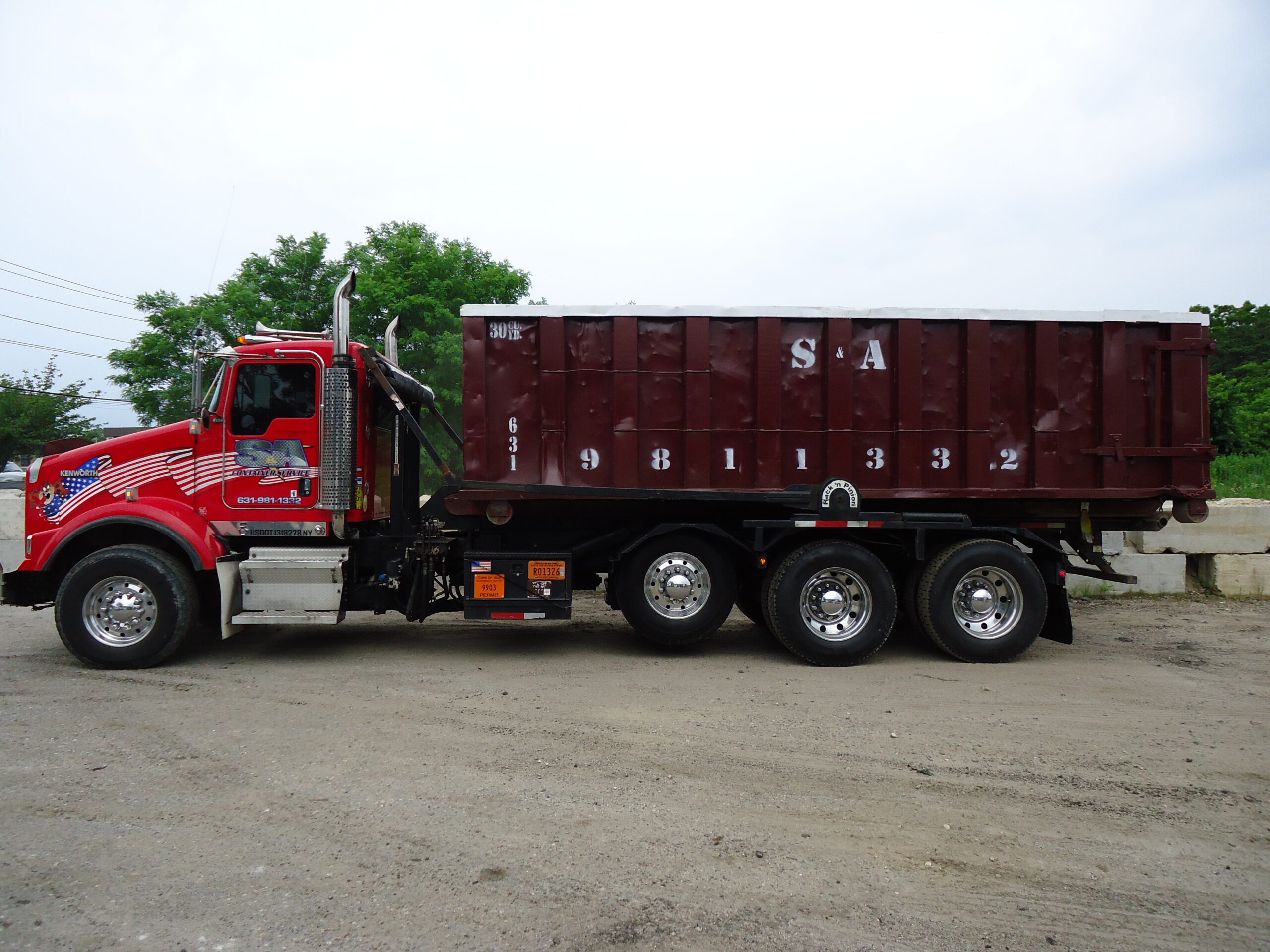
S&A Container Service 30YD Dumpster On Truck

Do You Need a Permit? (The Local Breakdown)

Private Property (No Permit Usually Required)

  • Driveways: The standard placement for most residential projects.
  • Job Sites: Areas within the property line of your construction project.
  • Village Exceptions: Be aware that “Gold Coast” estates and specific incorporated villages have unique aesthetic codes; some require “hidden” placement or specific time windows for delivery.

Public Right-of-Way (Permit Required)

  • Town/County Roads: Any placement on the street, shoulder, or public “right-of-way.”
  • Sidewalks: Blocking pedestrian paths in high-traffic village centers is strictly regulated.
  • Permit Lead Time: Local town clerks typically require at least 48 to 72 hours to process a street permit. You must have this document secured before our truck departs the yard.

However, permits are usually needed only if the dumpster will be located on a public road, shoulder, or right-of-way. As long as the dumpster remains wholly on your private property or in your driveway, there is usually no need for a permit. Another aspect that customers frequently overlook is that dumpster services have to be licensed to provide their services within a particular municipality. Nevertheless, this does not cover any placement permits necessary for each specific job.


In the case where the container will be located on a public street, it is usually necessary for the homeowner or contractor to get another permit. Sometimes, this can be included in the general building permit required for large-scale construction projects, although it is not always the case.


The biggest mistake made by customers is assuming that they do not need a permit, even though the dumpster encroaches on the public sidewalk.

dumpster

Trusted Dumpster

Rental Company

Trusted Dumpster Rental company

Placement Requirements: By the Numbers

While our trucks are designed to tackle the harshest debris that the region throws at us, they do require some breathing room:

  • Approach Path: 60 feet of linear distance is necessary to maneuver the truck into place.
  • Spacial Clearance: Our trucks require approximately 22 feet of clearance to operate, but the lifting boom can reach up to 30 feet in height during placement. Low-hanging power lines, cable wires, and tree branches that cross over driveways are one of the most common reasons a dumpster cannot be delivered. 
  • Width: A width of 10 feet is essential. It is particularly important to consider “no parking” areas and nearby residents’ vehicles along narrow streets near the water’s edge.

Make sure all vehicles are cleared from the driveway before delivery. Even one car left in the wrong position can prevent the truck from safely placing the container. If you have an electric vehicle that needs to be charged, plan placement carefully so there is still enough space to access the charging area while the dumpster is on site.

dumpster rentals

Permit & Placement Comparison

Placement Location

Permit Needed?

Risk Level

Protection Recommended?

Private Driveway

No

Low

Yes (Planks/Plywood)

Town/Village Street

Yes

High (Fines/Tow-away)

N/A (Street Placement)

Sandy/Coastal Soil

No

High (Sinking)

Mandatory (Plywood)

Commercial Lot

Usually No

Low

Optional

Avoiding the “Trip Fee”

In our very crowded area, a “Wasted Trip” generally occurs due to:

  • Cars of commuters or neighbors have blocked the access route to the street.
  • Overhanging tree branches have not been cut back to the required 22ft clearance height.
  • The driver has arrived, and upon inspection, realizes that the soft sandy surface will easily bury the truck’s stabilizers.

A wasted trip cost normally ranges from $150 to $250. Just a brief check of low wires and parking cars during delivery morning can save you some money.

One of the most common situations we see is a driveway that looks accessible but becomes blocked overnight by parked cars or delivery vehicles. Even a single car in the wrong spot can prevent the truck from safely placing the container. 

Safety for Street Placement

If your Town permit allows street placement:

  • Visibility: You may be required to use reflective cones, especially on unlit coastal roads.
  • Hydrants & Landmarks: Never block a fire hydrant or sit within 15 feet of a bus stop or “Historic Landmark” marker.
  • Drainage: Do not block storm drains; our local infrastructure is designed to move heavy rain/surges quickly to the basins.

Call Our Team For Help With Dumpster Placement

Navigating the various town codes from the Sound to the Sea can be a headache.

Our team helps customers:

  • Identify their specific Town/Village jurisdiction.
  • Provide technical specs for permit applications.
  • Review site photos to make sure the truck can clear trees and wires.

For a complete overview of dumpster rental logistics and weight limits, explore our Clean Concrete & Heavy Debris Guide and our full resource hub, Dumpster Rentals on the Island.

dumpster rental mastic ny

Surface Protection: Weather & Property Damage

Our weather is unfriendly to structures. Ranging from the freeze and thaw of February to the 90 degrees humid of July, your driveway will be subjected to danger:

The Plank Method

We highly recommend using two 2x4 wooden planks or plywood over your driveway. This will prevent the steel rollers from sinking into the asphalt or breaking the pavers.

Summer Heat Notice

On our warmest days, asphalt gets really soft. Without boards, your 10-ton container will leave a mark on your driveway.

Winter/Ice Conditions

Should your driveway be a very steep "North Shore" kind of hill, then it will need to be salted or sanded. The truck is unable to safely offload a container over a steep icy slope.

FAQ: Dumpster Rentals on The Island

Under local “Home Rule,” the permit must be held by the property owner or the licensed contractor. We provide the insurance certificates and truck specs to make your visit to the Town Hall as easy as possible.

Residential dumpster placement on driveways is often done using wood slats to better disperse weight and minimize surface damage. This holds true for standard driveway surfaces like gravel, dirt, concrete, paver stones, and asphalt.


The use of boards helps prevent:

  • Cracking
  • Scratching
  • Surface indentation

However, there is one important exception to be aware of.


Fresh Asphalt & Summer Heat

It is not advisable to put a dumpster on newly paved asphalt on the drive way. Although using boards, the effect of heat and weight will lead to damaging results.


For example:

  • An empty 20-yard dumpster can weigh 3,000–4,500 pounds
  • When loaded with construction debris, total weight can reach 10,000+ pounds

During summer months, asphalt becomes soft and more susceptible to pressure. Under this kind of weight, indentations or depressions can occur, especially from the wheels or contact points.


Best Practice

  • Schedule dumpster delivery before driveway paving is completed, or
  • Wait until cooler weather when the asphalt has had time to fully cure and harden

Planning around these conditions can help prevent unnecessary damage and protect your property.

While dumpsters can be placed on lawns, it’s important to understand that damage is very likely due to the combined weight of the truck and container.


In situations like full home renovations or job sites where the lawn will be removed anyway, this is usually not a concern. However, for finished properties, lawn placement should be carefully considered.


If lawn placement is required, customers must ensure that the area is clear of:

  • Septic systems or cesspools
  • Main lines running to or from the home
  • Irrigation or sprinkler systems

These systems can be damaged by the weight of the truck or the shifting of the container during delivery and pickup.

Communication is key. If your street is a “tight squeeze” or has weight-restricted bridges nearby, let us know so we can send the right equipment. We have smaller, light-duty single-axle trucks designed specifically for this. 

Between the salt air, the sun,and snow removal, our driveways are already stressed. Using wood planks is the absolute best way to guarantee your property remains pristine after the container is hauled away.

During winter months, driveways must be fully cleared of snow and ice prior to delivery or pickup. If the surface is not safely accessible, the driver may not be able to place or remove the container, which can result in delays or additional trip charges.